


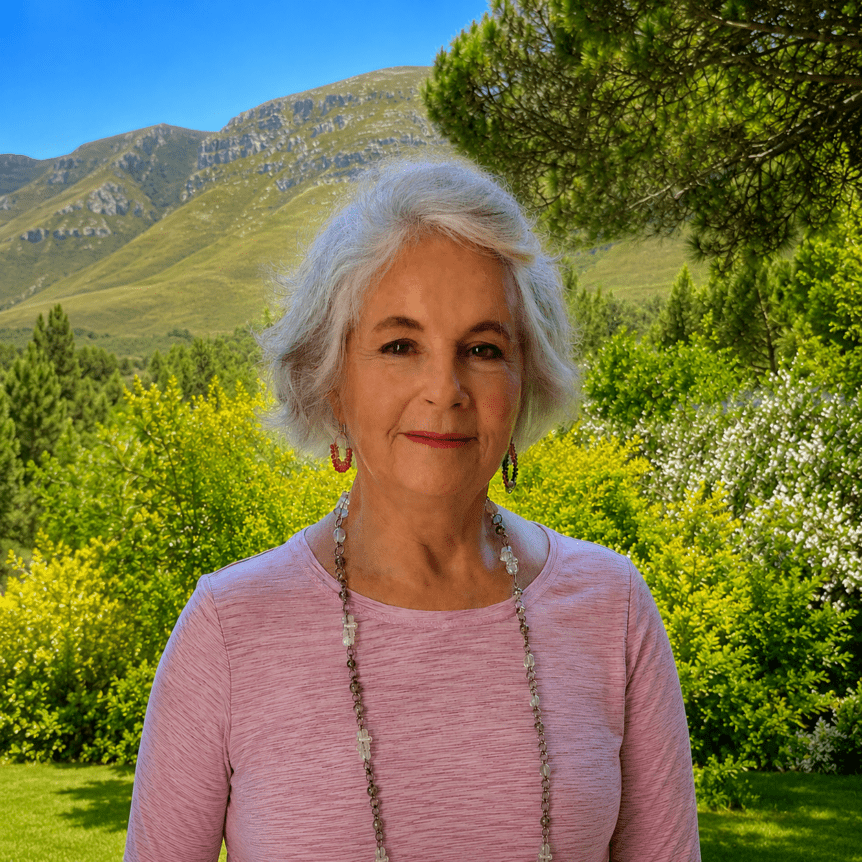
Did a career choose me, or did I choose it?
I recently learnt of the Careers Event that took place at Kingsmead College and am writing to the Newsletter in response to a request for input regarding the Communication Sciences Professions of Speech-Language Therapy and Audiology.
Does one choose a career, or does a career choose you? As a boarder at Kingsmead College during the 1950s and 1960s we walked every Sunday to St Martin’s in the Field to attend the early morning communion service. On the way, our neat crocodile of paired learners would pass the walls of St Vincent’s School for the Deaf. We knew the children behind the wall were deaf or hearing impaired, yet we could not grasp how being deaf could completely change the world one lived in. It seemed impossible to imagine a life without the sound of birds, cars, wind in the trees, or lions roaring at night; without being able to sing a song, or whisper nonsense in bathrooms; without being able to hear the whisper of ‘I love you’ into a mother’s ear, sounding different from me and you.
In 1962, the play The Miracle Worker showed at the theatre in Braamfontein. It tells the true story of how seven-year-old Helen Keller, who lost her hearing to meningitis at 18 months, learned to speak and listen due to the painstaking work of her teacher Annie Sullivan. Annie, a skilled teacher and somewhat of a martinet, unlocked Helen’s auditory memory, where the auditory traces of words and sounds from her early months lay dormant. Helen’s determination to participate in the world of language and laughter made a huge impression on me. I felt inspired to dedicate my own life to this field. The combination of school and play inspired me to believe I could contribute meaningfully to the world of sound, music and language.
Then, in 1959, at the end of the final term, my mother came to collect me from Kingsmead for the holidays. On the way home, we were involved in a serious motor accident when a small Ford and our car crashed head-on. My mother and I spent six months in hospital, but she was more seriously injured and required 24 surgeries to reconstruct her face and chest. Her foot was severed from her ankle.
For months, my mother attended the Speech Clinic at Wits. Her face and jaw were wired; she could not speak or eat, and we learned to feed her through a straw. Slowly, as the wires were removed, she regained the ability to eat and chew, and months later learned once again to speak. She was an inspiration in courage and determination, and the clinicians who treated her inspired me to work in the same field—communication sciences. My mother returned to practising as an architect years later when she could talk, eat and walk again.
I enrolled at Wits University on a scholarship in 1964 to study the B Speech and Hearing Therapy degree, launching a career in hearing science, neuroscience and linguistics, a field that has captivated me ever since. I have moved through various domains of learning and teaching, while also providing clinical services at tertiary hospitals and in private practice.
My primary focus has been on education, sharing knowledge at university level. I spent 23 years as a lecturer at three South African universities and at Queen Margaret University in Edinburgh. In South Africa, training programmes are linked to tertiary hospitals, and a requirement of appointment to teach is to practice clinically in the associated hospital. At each university, I was also a clinician: at Johannesburg General Hospital, Groote Schuur, Red Cross and Tygerberg Hospitals as university and hospital staff are also expected to conduct research.
Inspired by Helen Keller’s story, I focused on infants with meningitis at Red Cross Hospital, where children are hospitalised for treatment of the disease. During my Master’s degree research, I tested more than a thousand infants over two years and found that a significant number became deaf because of meningitis; depending on the bacteria, the degree of hearing loss could be mild or severe, as well as the course of recovery and outcomes. This enabled us, for the first time in South Africa, to obtain prevalence data—how many people in a population have or become deaf—and began a series of prevalence studies that I continued until 2020 to estimate the number of deaf people in this country.
The Master’s study was notable because, for the first time in South Africa, we could access advanced equipment at Red Cross Hospital that measured the electrical response to sound without requiring an infant or child to demonstrate a behavioural response, such as a startle or head turn, to a loud stimulus. Electrophysiology, though not new, was just beginning in South Africa. The Cadwell Electrophysiological Recording System at Red Cross Hospital was the first to start work in this field in the country.
Subsequent research has refined this field, giving us accurate records of how the brain processes sound, forming the foundation for speech, language, rhythm, song, and unique individual soundscapes. My colleague Nina Kraus at the Knowles Electronics Laboratory, Northwestern University, has developed the first ‘brain piano’, enabling us to listen to what the brain hears when it receives musical input. It is astounding to realise how sophisticated the human hearing system is.
Please listen to the YouTube clip that I have attached so that you can hear your brain on music! Electricity is indeed the currency of the brain.
At the same time, I became involved in the professional, organisational and institutional aspects of our profession, including training institutions and hospitals. I obtained a second Master’s degree in Health Services Management and was appointed to the Health Professions Council of South Africa, where I served as a member of the Council and Board Member for 11 years, including five years as head of my profession.
The work of the HPCSA is to guide the professions and protect the public, so I was involved in standards development, curriculum design and programme evaluation. Using these skills, I conducted a provincial audit for the Western Cape on how services should be developed, resulting in the blueprint for service development at community level (MOAS: 2010–2014). Most rewarding was the development of Primary Health Care Services for Persons with Disabilities, with a focus on Newborn Hearing Screening and Early Childhood Language Development. One of my dreams was to make services for deaf and disabled persons easily accessible at community level. During MOAS implementation, infants with hearing loss were being identified early and referred to Tygerberg Hospital for Cochlear Implants. Thanks to this technology, they learn to speak, just like you and me.
Let me return to Helen Keller and deafness. The Apartheid government created ‘Homelands’—desolate pockets of the country where most of the population was desperately poor and poorly educated. Part of government policy was to build ‘special schools’ for children with disabilities in these areas. This was where I first encountered Schools for the Deaf.’
My colleague, the exceptional late Claire Penn, had been commissioned by the SA Language Board to compile a dictionary of Sign Language, as there were many variations across the Homelands. Her research revealed 11 variations of Sign Language used throughout the country. Shortly after, I joined the SA Federation for the Deaf (now DeafSA) as a researcher, helping to answer the question: how large is the problem of deafness in South Africa? We collected data in Southern Africa, and years later I published a summary of this work in the International Journal of Audiology.
I could not forget the images of queues of people at visiting clinics we set up in the Homelands for hearing assessments. Another image that stayed with me was a road sign in what was then Venda stating: “Beware of handicapped children.” It summed up the lack of insight or compassion for people whose speech and language disabilities limited their ability to communicate. I became determined to work with colleagues from the Councils for the Blind, Physically Disabled, and other Disabilities to advocate for equal rights. Between 1993 and 1998, we established the National Co-ordinating Committee for the Disabled, which pursued equal rights for persons with disabilities. Reference to the SA Constitution 1996 will show you that Sign Language is acknowledged there but as an additional language, not one of the country’s official languages.
University programmes and NGOs focused on raising awareness of disabilities and promoting study in related fields, particularly the Allied Health Professions of Speech-Language, Occupational Therapy and Physiotherapy. Social work also played a key role. Wits University was a forerunner, establishing the Community Speech and Hearing Worker programme under Prof Myrtle Aron, later creating its Department for Deaf Studies to provide community-based early intervention through Hi Hopes programmes. Claire Penn’s work gained recognition, and the notion of a single Sign Language began to be accepted by government offices in health, education, and social welfare.
The NCCD initially dedicated a ministerial programme for disability in Vice President Thabo Mbeki’s office. Later, this became a separate department under Jay Naidoo. More importantly, advocacy programmes by the Deaf community gradually led South African society to accept Sign Language as a recognised language. Slowly, issues of disability gained recognition, especially that Sign Language follows linguistic rules and should be acknowledged in the Constitution. On 19 July 2023, I was overwhelmed watching SABC News when President Ramaphosa signed the Sign Language Bill into law, amending Section 6 of the Constitution to include Sign Language as the 12th official language. The Bill passed through Parliament a few months later. It took 25 years to achieve this from the early beginnings, but it was a heartwarming moment—the reward for decades of hard work and dedication.
My career took various turns, providing opportunities to meet many of the world’s leading professionals. My greatest teachers were the patients I saw; my skills largely stem from the insights they shared into the world of disability, deafness and speech-language disorders. While at UCT, I produced two documentary programmes, The Sound Barrier and Breaking the Sound Barrier, exploring the lived experiences of deaf patients, I had treated, and how hearing impairments affected their lives. It won awards for academic excellence.
I fondly recall Kingsmead College: prep in the dining room and outside the Music House, tennis matches, and the annual picnic at Zoo Lake. I remember Ms Cumberlege, meeting Ms Thompson at a gala celebration, Mrs Gehr knitting during Maths classes, and the peace of holy communion in St Brigid’s Chapel. Weekend music in Etunzi, Mrs Rawlings teaching me, and the Misses Matthews with their black cat wandering across assemblies remain vivid memories.
As Head Girl, I was privileged to know Miss Paver well and recall our Friday evening conversations, which covered both school matters and life in general. These were formative years: the values of the school, its founder Miss Thompson, and principal Miss Paver were an inspiration and a model to live by. Autonomy, the freedom to choose that Franc suggests, is a key principle for living a good and moral life. Leal, or loyalty, is both a responsibility and a gift—a promise to honour and respect all whom we encounter on life’s journey.
I have not yet mentioned the many patients who taught me about language and listening, normal and abnormal, as we worked together on hearing, speaking, and attending to sound. Nor have I mentioned the hundreds of students I had the privilege to teach, inspiring them with a passion for how we hear, construct messages, code speech signals, and use the tools of language—spoken or signed—while understanding how our brains process the myriad sounds of our world to make meaning.
Did I choose my career, or did it choose me? It is like the chicken and egg question. I can only say that my profession, broadly defined as communication sciences, has afforded me endless opportunities for a rich and fulfilling life.
Herewith the link to the YouTube clips about Sound Mind, the work of my colleague Nina Kraus, whose research has influenced me since we first met at Breckinridge, US, in 1989.